Conversations and hot topics heard in the exhibit hall at RTS 2026
It’s probably too early – okay, definitely too early – to draw any definitive conclusions, but if the conversations we had in the exhibit hall at the just-concluded Retail Technology Show (RTS) in London are any indication, we may in fact be seeing a shift in the conversations about AI.
Let’s look at why I think this may be the case.
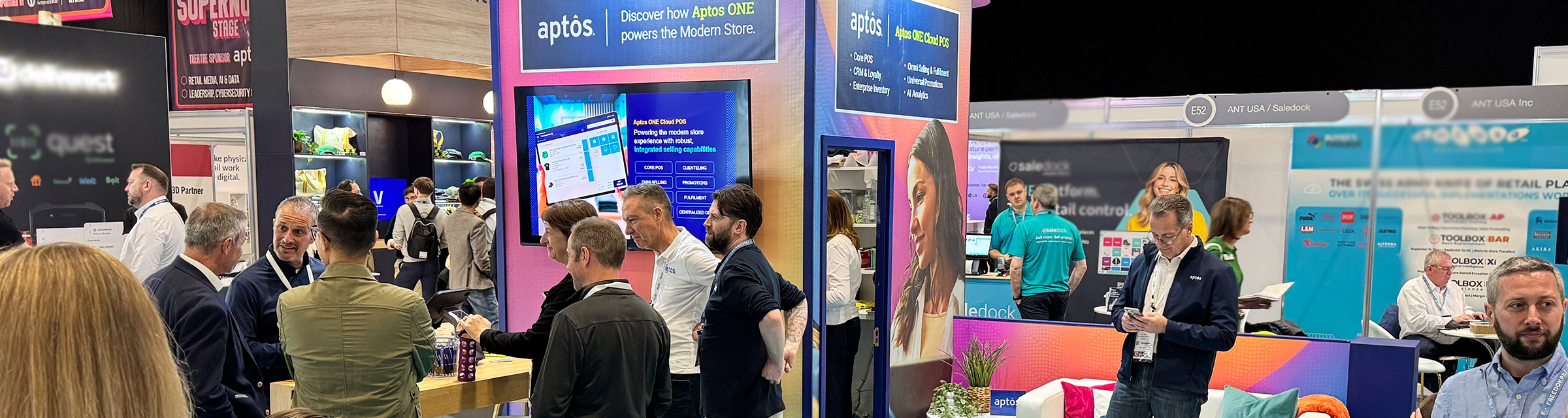
RTS 2026 brought more than 15,000 retail professionals and 450 retail technology suppliers together for two days of presentations, round tables, workshops and networking centred on the role of technology in retail’s present and near future. Aptos once again sponsored The Retail Café, which always gives us an excellent opportunity to chat with attendees while they enjoy a much-needed break from all the sessions and supplier stands.
While in the café, retailers shared with us some of their thoughts and opinions about what’s next on their technology investment priority list. And perhaps surprisingly, AI didn’t dominate those lists. AI was a topic of conversation, of course, but it didn’t dominate the conversations this year. And when AI did come up, it came with the types of questions that have been “standard operating procedure” for pretty much every other emerging technology that has appeared on the scene for as long as I have been in retail:
- Retailers are asking about the actual return on investment (aka value) they can expect from their AI investments. A study conducted during the show by the technology PR firm ASPR indicated that proving return on investment is the single biggest challenge facing retailers when it comes to technology.
- Retailers are asking what preparations need to be in place for their enterprise to be fully prepared to extract maximum value from their investments in AI.
- They are questioning the frenetic uncertainty of the AI industry and environment and how that impacts their investments.
- They are questioning the level of hype surrounding AI. That same ASPR study conducted during the show found that one in four retailers surveyed believes AI is either overhyped or actively creating confusion.
- And retailers are questioning the reliability and trustworthiness of AI. We didn’t speak to anyone who was actually excited about the prospect of trusting AI to handle a mission-critical, regulation-laden application like POS.
People are now fully recognising that you have to have a good data foundation in place before you can begin to reap any of the benefits of investments in AI. There was in fact a real buzz on the show floor around laying a solid data foundation in order to position the enterprise for deriving maximum value from AI once they start signing off on the investment.
During one session, Dan Chasle, Chief Data Officer at New Look, said that “AI is transforming our internal processes from product inception through to the checkout.” Chasle went on to share a number of examples from his organisation where AI tools have to be fed clean data and tasked appropriately in order to get the best out of them.
Most everyone at the show indicated they are certainly watching AI developments closely, but in the short term, anyway, they are focusing on getting their data foundation in order while also looking at other technology investments that can move the needle more quickly and more definitively.
These are a few of the things that were atop many investment lists for the retailers we spoke with:
- More retailers are rethinking click & collect as a driver for investment in mobile. They told us they want to leverage more store inventory more often, rather than sending pickup orders to the store from the warehouse.
- The profitability of store fulfilment was also a hot topic at RTS 2026. Everyone recognises that they have to offer click & collect and other store fulfilment options, but they also know they can’t continue to simply offer store fulfilment options without a serious look at the profitability of each service. Many are asking how to best measure and optimise store picking and packing options versus warehouse shipments to the store for customer pickup.
- Many of the retailers we spoke with want their associates to have the tools they need to save more sales, which is another opportunity for an investment in mobile POS to drive value.
- With regard to those mobile investments, Android was more dominant than I recall it being at RTS in years past. There were many hardware suppliers in the exhibit hall, and pretty much every one of them was leading with Android devices.
- Given the instability and uncertainty in the global economy, budget concerns were a constant theme. It seems everyone is up against serious budget constraints, and those constraints coloured many of our conversations.
- Despite the budget concerns, however, many retailers told us that they can no longer continue to wait and see where AI goes, because that waiting has delayed many investments in technologies that drive ROI right now. As a result, they are seriously looking to make core technology investments that fit within their budget frameworks.
- Understanding both the TCO and the ROI of any potential technology investments was also a theme of many conversations. Retail leaders know they have to move, but they simply can’t do so without a) a real understanding of how each investment will impact the bottom line now and b) a high degree of confidence in how it will impact the top line in the very near future.
So that’s my summary of what we were hearing in the exhibit hall. A lot of questions about AI but not a lot of commitments to AI, other than investing in better data foundations to help prepare for future investments in AI solutions. There were also strong commitments to investing in technologies that have a real, tangible impact on retail performance: improving store operations, mobilising associates, leveraging store inventory, personalising customer experiences and better integrating omnichannel capabilities into their stores.