
Where retail is heading: one customer across channels
At Stripe, we spend a lot of time thinking about where retail is heading, and the holiday season tends to reveal what’s not working. Take this common scenario: A shopper who has bought from a retailer all year is standing in the retailer’s store. Her full order history, including a few items she left in her cart last week, sits in a system the store can’t see. The associate on the floor treats her like a stranger, and a year of loyalty is lost between two systems.
Stripe’s recent research shows that shoppers still rely on stores, and they expect the store to know what the website knows. Most retailers’ systems aren’t built for that yet. Retailers that close this gap will deliver the unified commerce experience consumers now expect.

Shoppers still rely on stores
For years the story has been that physical retail is declining. We wanted to test that assumption. We worked with YouGov to survey 1,810 shoppers across six countries: Australia, France, Germany, Japan, the UK, and the US.
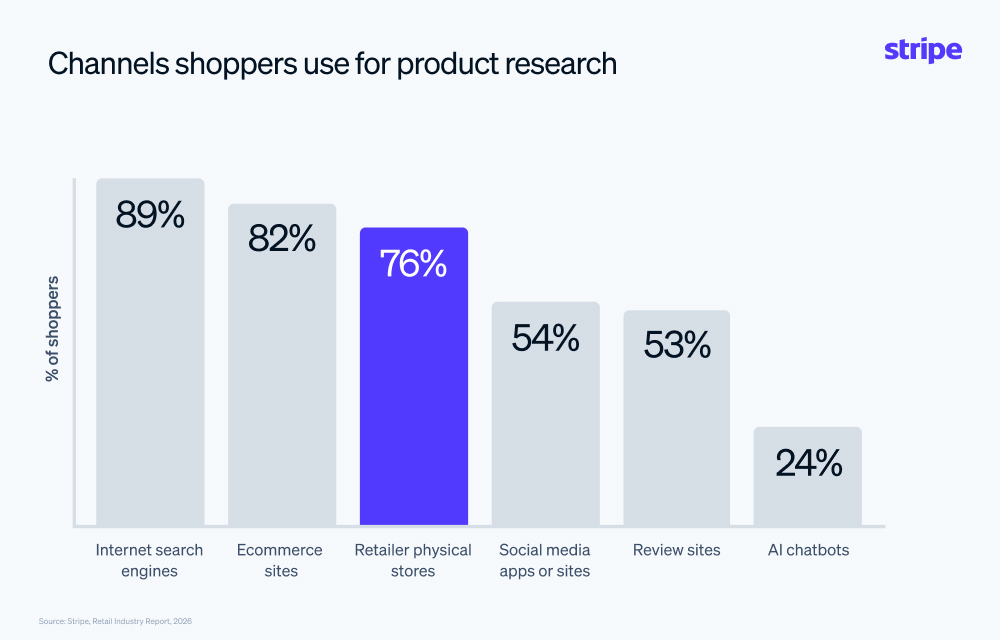
The findings were clear. Seventy-six percent of shoppers use physical stores when they research brands or products. That’s ahead of social media (54%) and well ahead of AI chatbots (24%). Only internet search engines (89%) and e-commerce sites (82%) rank higher.
And shoppers know what they want once they’re inside. Nearly half (45%) say personalized recommendations based on their online order history are an important part of the in-store experience. They want the associate to know what the store’s website knows.
Those results signal a shift in what shoppers expect from physical stores — not just a place to browse, but a place that knows them. Shoppers now expect to be recognized there, and most retailers haven’t caught up.
Why unified commerce is where retail is heading
Most retailers don’t have one system that handles both the store and the website, and it’s rarely by choice. Many replace their point-of-sale (POS) system in one project and modernize payments in another. The two projects end up waiting on each other, which can slow both. Each new market can mean setting up payments again, often with its own middleware. Adding more tools often makes it worse. Your customer information ends up in too many places, and checkout feels different from one channel to the next. Unified commerce takes a different approach: one customer, one order, and one payment record shared across the web, your store, and in-app activity.
Shoppers already behave this way. They move across websites, apps, and retail locations without thinking of them as separate. The systems are the part that has to catch up.
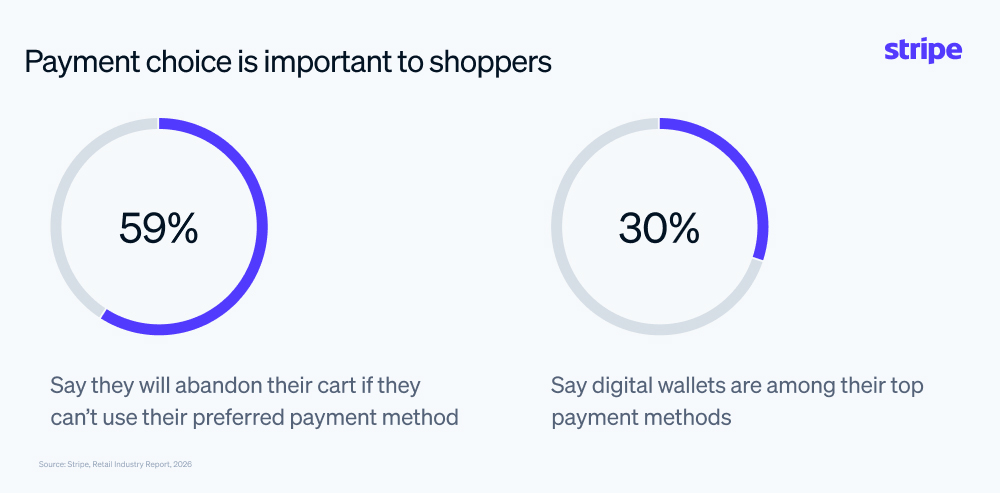
I’d start with payments because the payment record exists in both channels, which makes it the natural link between online and in-store activity. Payments are also where shoppers make their expectations known. In our survey, 59% of shoppers say they will abandon an online cart if their preferred payment method isn’t offered. In the same survey, 30% name digital wallets among their top payment methods. Wallets, QR code payments, and buy now, pay later options now work on in-store readers. Keeping those options consistent across channels is simpler when one system handles both.
For most retailers, the biggest hurdles are effort and cost. One way to manage both is to avoid doing the job twice. When you replace your POS system and payments separately, each project has its own timeline, testing, and certification. Each waits on the other. Done together, the work is one project.
Getting there doesn’t require doing everything at once. Capabilities such as ordering online and picking up in store, shipping from a nearby location, and matching returns to the original payment can be added one at a time. Pick one, prove it in a pilot, then extend it.
The Stripe app for Aptos ONE
Stripe and Aptos recently launched the Stripe app for Aptos ONE. Stripe Terminal readers in the store connect directly to Aptos ONE. If you also use Stripe for online payments, you can bring in-store payments, online payments, and your POS together in one system.
The integration is certified and built for Aptos ONE, so it isn’t a custom build. The app allows you to retire the market-specific payment middleware you may run today. Then you can set up payments once and extend them country by country. Expanding internationally doesn’t mean starting over; Terminal already handles in-person payments in 39 markets, and Stripe supports 100+ payment methods around the world.
The retailers that bring their systems together first will be well positioned to meet what shoppers now expect. The shopper who walks into your store this holiday season is the same person who shops on your site. The question is whether your systems know that yet.
Learn more about how Stripe and Aptos ONE bring payments and POS together.